Sunday, April 30, 2017

Book Review: "Scandinavian Song: A Guide to Swedish, Norwegian, and Danish Repertoire and Diction"

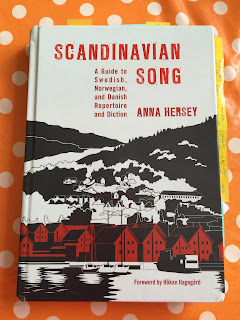
 Scandinavian Song


A few years ago on The Diction Police podcast, we published episodes on Swedish and Norwegian Lyric Diction--I was eager to delve into them, because at the time there were very few resources available for singers in these languages. After the Swedish podcasts aired, Anna Hersey sent me an excellent article that she had written for the NATS Journal of Singing entitled "An Introduction to Swedish Diction", which was the basis for her doctoral dissertation. The moment she announced that she would be writing a diction book on all three of the Scandinavian languages, I waited not-so-patiently for the release date!

Now Scandinavian Song is out, and I've had the opportunity to work my way through it for the past few months with great pleasure. If you look closely at the above picture, you can see all the yellow post-its along the side--these mark all the information I want to be able to refer to at a glance! As you can see, there are a lot of them, because there is an incredible amount of information in this book.


The book is divided into three parts, which are all in turn divided into three sections (one for each language):

Part 1 covers the rules of lyric diction in Swedish, Norwegian, and Danish, with in-depth explanations of the vowels and consonants, how they are formed, and the standard performance practice of native-speaking performers, as well as the basic grammar necessary for understanding the rules. While on paper these languages appear to be exactly the same (to a foreign eye), there are major differences in the pronunciation of them, and each of these details is clearly defined and explained.


What I appreciate most about Part 1 is that Dr. Hersey discusses the new phonetic symbols that we need (like [ɶ] and [ʉ]) both with the regular linguistic definition and with a more colloquial, less formal explanation, which makes it accessible for all levels of diction study. She also gives step-by-step instructions on how to get started as a sort of checklist for those of us with little experience in the language, and in each language she recommends the best dictionaries and other resources to acquire as a reference to aid in further study.

Part 2 is a chronological list of composers for the repertoire of each language, along with stylistic and interpretive information for each song that is mentioned. The detail in this section is staggering--she discusses the setting and text in a way that reminds me of Pierre Bernac's Interpretation of French Song.


Part 3 has over 200 pages of phonetic transcriptions and poetic translations of songs, with background information on the poets. This book is worth having just for this portion! But I wouldn't recommend starting from this section--working through the first two parts of the book will lend a much better understanding of how to use the transcriptions effectively.

I've been working my way through Part 3 armed with YouTube--I find one or two clips of each song and listen while following along carefully. These are composers that I've seldom heard before, and it's been a wonderful way to get introduced to new repertoire, as well as the linguistic differences and musical languages of each country.

***

One of the greatest joys of lyric diction right now is that there is a great deal of research coming out on many languages besides the big three (Italian, German, and French). It's an exciting time, because we no longer have to sing the same repertoire in every recital, and Anna Hersey's book just opened up three new languages for us to program into performances! Scandinavian Song is a must-have in any reference library.

--Ellen


Wednesday, March 29, 2017

The birth of an opera: the libretto workshop

As a vocal coach at the Crane School of Music, I've been fortunate to be involved in the Pellicciotti Opera Composition Prize, which fosters the development and creation of new American opera. Every four years, the prize allows us to commission and produce a new operatic work for our main stage, giving students and faculty the opportunity to participate in every step of the creative process. New American works have been flourishing lately, usually under the patronage of major regional and national professional companies, and it is somewhat unusual for a music school to be able to contribute to the repertoire in such a significant way.


In this post, I thought I'd write about a step in the process with which I was unfamiliar, but that I found to be absolutely fascinating: the libretto workshop and reading.

The winner of the second edition of the Pellicciotti Prize is the amazing Tom Cipullo, with his opera Mayo. Cipullo also wrote the libretto for the new work, which tells of America’s tragic infatuation with eugenics (according to Wikipedia "a practice that aims at improving the genetic quality of the human population") in the early 20th century. Based on a true story, the opera follows the life of Mayo Buckner, who was committed to the Iowa Home for Feeble-Minded Children at the age of eight, and forged a life of quiet dignity and meaning while living there for the next 60 years.

In February, as part of the development of the work, we organized a libretto workshop: two days of table readings with a group of actors, culminating in a public performance of the libretto (no music, just straight theater) and a moderated audience feedback session at Opera America in New York City. Dramaturg Cori Ellison and director Beth Greenberg were leading the rehearsals along with Tom Cipullo. Music Director Kirk Severtson and I were also present during the whole process.
The workshop was structured as follows:
  • Two 3-hour rehearsals (table reading)
  • A public performance of the libretto
  • A moderated feedback session
It was absolutely fascinating to witness this text come to life! Unusually, Tom Cipullo is both the librettist and composer for the piece. This solves some of the problems that teams of librettists and composers might typically encounter (for instance, this way "everybody" is automatically on the same page), but it also presents some challenges, since the creator is not afforded the kind of back-and-forth discussion that can be very beneficial and fruitful.

Table reading
Table reading

The actors were all theater actors, not singers, and not particularly involved in the operatic world. This yielded some very interesting remarks, and discoveries (I should also point that each actor played multiple parts, and that one actor was always assigned to read all the stage directions).
  •  One topic that kept coming back was the difficulty of reading the "arias": as opera practitioners, we take arias for granted, but as a piece of theater, they are somewhat incongruous, since they tend to halt the natural flow of the plot, a fact that becomes particularly evident when the libretto is simply read. They also often contain quite a bit of text repetition. The solution offered by the director and dramaturg, was to treat them as pieces of poetry, or even Shakespearean  monologues (although those don't usually repeat text all that much).
  • At one point, a question was raised about the motivations of one of the characters. Tom's answer was that he would like to leave it somewhat ambiguous, to which the actor responded: "I don't know how to act "ambiguous", so I need to know where she is coming from. Otherwise, it won't read at all". This was quite interesting: Tom's intention was to leave this undecided for the audience, but that didn't mean that it could be left undecided for the actor herself.
  • Another aspect discussed was how the plot transitioned from scene to scene and from one act to the next. The story covers about 50 years, and given this span, it is important that the events depicted related to each other in a coherent way, without creating false causal links. Something that might be clear in the librettist's mind, might not come across as clearly to the audience.
  • The power of music: on more than one occasion, the fact the music "will flesh this out" was brought up. While the libretto is a functional piece of theater of its own, it also will nourish the music for the piece, and in turn, flourish with it.
The performance itself took place at Opera America, in Scorca Hall, in front of an invited audience of about 40. The actors were sitting next to each other on stage in front of music stands, and would rise up when their character was in the scene.

Audience in Scorca Hall, Opera America
Performance in Scorca Hall, Opera America

I was in awe of the actors, who, in a very short time, were able to deliver such nuanced renditions of their characters, and to also incorporate comments from Cori, Beth and Tom. They had no prior knowledge of the story, the plot, or the background, and yet the performance was absolutely convincing and touching. To be able to do this with 6 hours of rehearsal over a day and a half was very impressive. I mentioned this to one of them after the performance, and she simply answered: "We do these kinds of readings all the time, sometimes with no rehearsal at all. We're used to it". I wonder if this is the equivalent of sight-reading for us musicians...

After the performance, Cori Ellison led the audience through a moderated feedback session. Cori, Beth Greenberg and Tom Cipullo were on stage to receive the audience's comments and answer questions. Cori used Liz Lerman's critical response process for this, which is comprised of four parts:
  1. Statement of meaning: audience members express what was meaningful to them, what "got" to them in the piece. These should be specific, and positive comments, such as "I loved it when...", or "I was moved by...".
  2. Questions from the librettist to the audience: the writer asks, the audience responds, and a dialogue ensues. For instance: "Was it clear to you that...?", "what did you think of...?".
  3.  Questions from the group to the librettist: sometimes what is clear to the librettist is not clear for the audience, and some points of the plot might need clarification. This is helpful for the composer/librettist in order to gain a different perspective than his own on the work.
  4. Opinions: audience members can express opinions about any aspect of the work BUT, they have to ask the writer whether he/she would like to hear them. Sometimes, hearing an opinion might influence the piece too much, or inadvertently push it in a direction that wasn't the writer's initial intent. The audience member would ask: "I have an opinion about such and such, would you like to hear it?". In our case, Tom was very willing to hear these.
The session proved to be very lively and engaging. Almost everyone in attendance contributed to a very meaningful and interesting discussion about all aspects of what they heard: from the importance of telling this particular story, the clarity of the plot, and definition of characters, to the placement of the intermission, and the overall dramatic effect of the work.

Moderated feedback session

I realize I haven't said much about the actual story: I simply don't want to give anything away about Tom Cipullo's telling of it. However you can read about Mayo Buckner here.

The next step in the process will be a music workshop of the whole piece, sometime in January 2018. Stay tuned for a blog post about that! The premiere of Mayo will take place in November 2018, at the Crane School of Music, in Potsdam, NY. You can visit the Pellicciotti Facebook page, to follow along with the project.

--François


Monday, February 20, 2017

Making the case for Lyric Diction


Making the case for Lyric Diction/IPA


Hello and welcome to The Diction Police’s new blog! François and I will each be posting once a month on any topic that strikes our fancy—this won’t be diction lessons, but rather personal and professional anecdotes, observations, and musings. For our first posting, I thought it would be best to talk a little about why we find lyric diction so important.

Over the decades as someone who specializes in the study of lyric diction, one of the attitudes that I’ve run across from time to time is that studying diction is pointless, a waste of time, charlatanism to take money from students—all anyone really needs to do is to learn to speak the language, and that will be enough to make their pronunciation in singing clear.

Let’s take a closer look at some of the arguments I’ve heard over the years:


Speaking the language is enough

If this were true, then every native speaker of a language would be completely comprehensible when they sing. You’ve never heard an American singing “O Holy Night” and thought, “Wow, I have no idea what they are saying”? Being fluent in a language does not mean that you make no diction mistakes or that people will understand you when singing. There are many people living in Germany for over 20 years who sound more American than I when speaking the language. Being a native speaker is also no help, because oftentimes in both English and German we will swallow consonants that on an opera stage need to be spit loudly in order to be intelligible, and we don’t notice it because we aren’t aware of the problem—we understand what we are singing. There are rules for lyric diction in French that supersede colloquial pronunciation, but not all French coaches and singers know them unless they have actually studied diction. I’ve fought (and won) fights with French speakers over forbidden liaisons. One of my friends (not American) was a French minor in college and speaks quite well, but she still didn’t know that the second syllable of “solennel” is not a schwa and I had to correct her and the people she was coaching. Speaking the language is a great start, but it isn’t the end of the journey and it can’t teach us everything about pronunciation.


The rules of diction were made up by vocal coaches

RAI (the Italian television) has a website dedicated to pronunciation for television and radio that also applies to Italian lyric diction, and everyone knows of the Zingarelli dictionary, because it contains the Italian standard of pronunciation. Fouché’s Traité de prononciation française harkens back to the 1950s, and the Sieb’s Bühnenaussprache (stage diction) came out in 1898. The German German diction book, Der kleine Hey, is excerpted from a much longer book written by a voice teacher at the turn of the last century, too. These are not random rules that Nico Castel recently made up to create a new field of study for singers to waste their time and money with—if it were, all of these resources would only have been made for Americans, because we are the only ones who have diction classes. These are worldwide industry standards for anyone using their voice to make their living in these languages, be they opera singers, actors, commentators, or newspeople.


Any native-speaker can tell you whether or not they understand you

While that may be technically true, not every native-speaker knows whether you are pronouncing the words correctly. In fact, native-speakers tend to have a much lower standard when it comes to foreigners singing in their language, because they automatically allow for a few mistakes as long as the general gist is there. On the other side of that coin, not everyone can truly understand language when it’s sung—my brother speaks fluent English, but he would have a difficult time understanding the best rendition of “Must the winter come so soon” because he’s not used to listening to words stretched out so long.


Coaches listen only for syllables and not expression of the language

I’m in the middle of Carmen rehearsals right now, and in the 2nd act finale, the smugglers try to convince Don José to come with them, and one phrase is “tu t’y feras quand tu verras la-bas”. As a coach, this is a phrase to keep an ear out for—the tendency is to open “feras” because singers want it to rhyme with “verras”. Some of the best singers in the world can get this flipped around because it goes by quickly, and some coaches wouldn’t even hear it happening. So yes, sometimes we listen for syllables—because we have to, because sometimes they are standard mistakes that are made often. But we are also always listening for line and expression and music. Don’t confuse the fact that we are correcting a syllable here and there for the fact that we aren’t listening for anything else.


Diction coaches aren’t qualified to tell someone how to sing something because they don’t have any vocal pedagogy

All of the diction coaches I know have been singers, voice teachers, actors, or vocal coaches. Each of them has their own strengths and weaknesses, depending on their training, whether they accompanied voice lessons during their studies, or with whom they studied. Each of them has something to offer, and it’s up to the singer to apply what works and what doesn’t according to their own technique. This gets easier as a singer gets older and more established with their own technique.


Diction/IPA is a crutch so that you don’t have to learn the language

Absolutely not!! Learning your languages is an essential part of becoming an opera singer, and diction does not replace the study of language. What it does is give us a common ground to work from in a coaching. If you are accidentally singing “füllen” with [y], then you are actually singing “fühlen”. If you know the difference between [y] and [ʏ], you can simply write in the appropriate vowel. Both of these are common words in German, which means that neither will sound incorrect to our foreign ears, so having a shorthand to notate this is crucial.

My first production in Germany was Dialogues des Carmélites in French. With all German singers. None of whom could speak French, none of whom knew IPA and at the time I could barely muddle my way through German. It led to hours upon hours of trying to find a way to explain the sounds, and them trying to find a way to notate their music that would help them practice when I wasn’t there and it was frustrating for everyone. Over the years, I’ve seen people develop their own shorthand, which is totally fine—you don’t HAVE to use the IPA symbol, as long as you have a symbol that makes sense to you without question later, but we do need a jumping-off point to get started. IPA makes it easier to connect initially.


Pronouncing everything ruins the legato

Good diction helps place the voice properly. If the vowels are not in the sweet spot, comprehension is greatly reduced. If an American sings the ‘l’ back in the throat, it can cause tension—if they follow diction rules and sing an Italianate ‘l’, it will help alleviate some of that tension and keep the voice forward. Sometimes people try to over-pronounce, and that is just as difficult to understand. There is a balance between doing enough to make yourself comprehensible, and trying so hard to clearly articulate every syllable that the legato line is disturbed.

All of this being said—diction is not a suicide pact! According to the laws of physics (Carnegie Mellon actually had a class on Physics of Sound, it was fascinating), certain vowels resonate better at certain frequencies, so vowel modification is actually a thing and can be a great tool—if you know what vowel to modify to. When it comes to consonants, it you are on a note above the staff and singing an ‘m’ will cause your jaw to lock and the voice to squeak, don’t sing the ‘m’! But there are ways to trick the audience into thinking they’ve heard an ‘m’ in that situation, too, and a good coach can offer suggestions and options to make that shift.

*****
In closing, the important thing to remember is that diction is a tool. Diction is NOT the end result. Simply marking in open and closed vowels is not the study of diction and when you've done that it doesn't mean you're “done”. Diction gives you the means by which you can make yourself understandable and by which a coach can help you to improve. Gone are the days when singers can specialize their entire lives in a certain language or repertoire. Today’s young singers must be well-versed in enough languages and styles to make themselves marketable in order to get to the next level, where they can then be a little more specific. Adding this tool into your language/practice arsenal can help make everything else run more smoothly.


--Ellen