Saturday, March 31, 2018

Getting the most out of your vocal coaching: a short guide for the young singer (Part 1 of 2)


The relationship between a singer and their coach(es) is important, and one that will last throughout your career. It is therefore crucial to learn early on how to make the most of these sessions, and establish the best possible working relationship. Young singers don’t always know the difference between a voice lesson and a coaching, so here are some ideas to consider before you walk into your next coaching:

COME EQUIPPED

- Bring two copies of your score:
Your own working copy, and one for the coach. Don’t assume that you will simply look over your coach’s shoulder; your coach’s copy should be “user friendly”: no lose sheets, clean, with nothing cut off (I’ve become really good at improvising bass lines that have been cut off the bottom of the page, but still), double sided, and preferably in a binder; you have to be able to take notes and mark your own working copy easily, the same one that you take to your voice lessons. Over time, these scores become real treasure troves of information, and you will enjoy going back to them years later.

- Bring pencils:
It seems obvious, but you wouldn’t believe the amount of coachings I’ve had where the singer didn’t bring a pencil. I even recommend having a few different colors, in case a particular point needs to be emphasized, or highlighted in order to better grab your attention.

- Bring a recording device: It is so easy nowadays to record a coaching on a phone or a digital recorder, yet a lot of singers don’t do it systematically, probably assuming that they will remember things. That simply won’t be the case, and it is always useful to hear yourself back, in order to reinforce the points that you worked on in a given session.

COME PREPARED

- Please warm up:
You should be warmed up for a coaching, the same way you would be a for a voice lesson. The reason is simple: you want to be able to sing well, and not spend time solving vocal difficulties that are really only the result of not being warmed up.

- Work on your text ahead of time:
Translate every word of the text; Depending on your level of proficiency with a language, this should be done directly on the copy of the music you are using. Memorizing the translation is crucial to a good performance: how is an audience to believe you, if you don’t understand what you are singing AT ALL TIMES? Additionally, a coaching will be more efficient, and interesting if you can discuss meaning with your coach, without having to constantly refer to a written translation. This takes a lot of time, and practice, but the more you sing in a given language, the easier this will come. Think about how it feels to sing in your own language: each sound you make, each syllable you sing carries meaning, and is part of a broader dramatic purpose. It should be the same in a foreign language that you don’t speak.

- Work on diction ahead of time:
A major focus of any coaching is the acquisition and delivery of proper diction. Most coaches are trained in lyric diction, and can help the singers to navigate through the sounds, the inflections and the flavor of a foreign language. That is not to say that you should rely solely on your coach for this work, and you can take a number of proactive steps to ensure that the coaching is dedicated to fine-tuning and refining:
·      Make an IPA transcription
·      If you are not familiar enough with the language, get a transcription online (www.dictionpolice.com)
·      Listen to native speakers speak your text, and listen to singers in their native language

- Be prepared musically:
Coaches are happy to “be your ears”, but we shouldn’t also be your brain. Learn rhythms and pitches accurately. We don't mind "plunking out" pitches occasionally, but really, all the preparation work you can do on your own should be done before the coaching.

- Do your research:
This is very important for a coaching, and a prerequisite to any discussion of interpretation and character.
·      If you are working on an art song: research both composer and poet; know where the song fits in the cycle, if it is part of a cycle (Schumann’s Im wunderschönen Monat Mai takes on a different meaning, when you know what happens in the rest of Dichterliebe). Establish a character: who is singing? to whom? what “happens” during the piano prelude and postlude? etc...
·      If you are working on aria:
It’s a great excuse to watch the whole opera. (Most common repertoire is available online, either on Youtube, or through services like the Metplayer. Your school library might even have a subscription).
If you are working from an anthology, go get the entire opera score, so that you can see what happens right before your aria, and what prompts your character to sing is, and what happens after, so you can know what your character achieved in that moment.

COACHING ETIQUETTE


- The coach/voice teacher relationship:
We are your team, and we work toward the same goal: making you the greatest singer you can be. Sometimes, it might feel like you are getting conflicting information from us. Most of the time, we are expressing a similar idea in different ways, and it is your job to figure out how to reconcile both. But sometimes, we have different ideas about a particular point, and that is not the end of the world. Rather, try to understand what approach works for you, and build your own informed opinion on the matter.

- Repertoire:
Coaches know a lot of repertoire, but if you are planning on working on something unusual, please let us know, and maybe give us the music ahead of time. We will still be able to work with you on something we don’t know, but the more we know the piece, the best we can help you achieve your vision.

Part 2 of this post is also available here!

If you have any other tricks, strategies, ideas on how to make your coaching as efficient as possible, please share them in the comments... In the meantime, happy coachings!

--François

Wednesday, February 28, 2018

Fake it til you make it

You know the phrase “Fake it til you make it”? There may be a whole lot more to that than we think. I found a Scientific American article about a Harvard Social Psychology study regarding posture—and they found that actual physical posture is linked to the endocrine system. Oddly enough, the study showed that rather than hormone levels changing and then a confident posture came as a result, if the person was placed in a physically powerful posture, in a ridiculously short amount of time, their hormone levels would change to correspond to it. To me that means that if we act like we’re secure, we’ll actually feel more secure. In addition to that, people respond to each other based on these non-verbal physical cues. So if we see someone who acts like they know what they’re doing, we relax and assume that they do.


In undergrad, I studied Alexander Technique, which, if you haven’t heard of it, is basically a body learning technique. The basic principle is about is how the head sits on top of the spine, the neck's relationship to the spine. It also talks a lot about the Fight-or-Flight response and how we get stuck in that—that just means, whenever we get nervous, our necks shorten so that our bodies are prepared to either fight something or run away from it. It’s a natural reaction that every animal has—just watch Miss Kitty Fantastico when she’s about to make a high jump, and you see her entire spine shorten like a spring so that it can lengthen into the jump. We all have the same process built into us, but because we get nervous and then stay there (like in an audition), we don’t lengthen out of that spring, and our bodies aren’t always functioning as efficiently as they can.


Especially in an audition situation, this reflex is something to work out. We’re all insecure. As I like to say, anyone who tells you they aren’t insecure is lying about it because they are insecure about it. So fake it—not with overconfidence, but with pure physiology. In your practice, find techniques that get you to stand up straight, without tension, that give you a feeling of openness, strength and relaxation at the same time. Tie it into the breath, so that before you walk into the audition, you can take a good breath and get your body into line. Pretend that you are comfortable so that the auditioners are relaxed and ready to listen, rather than feeling for your nerves.

The best example I have personally happened when I was first on staff at Carnegie Mellon University. My best friend and roommate at the time was still a voice student there, and she auditioned for the Concerto Competition with a song cycle she and I had also performed on her junior recital. They heard one piece and then asked for the slowest movement in the cycle—and somewhere on the second page of that, she lost her place completely. My page turner looked at me in horror, cause whatever we were playing had nothing to do with what was on the page—and I mean that very seriously. We made up 2 entire pages of music together, it must have lasted almost a solid minute. The judges even had a copy of the score to follow along. 


And you know what? She won the competition! She and I never panicked, she never looked as though she was lost, she just kept singing convincingly, I just kept playing convincingly, and even though it had nothing to do with the actual piece, the judges never even noticed that, they never even looked down at the music. They only noticed how beautifully she sang.

Now I'm NOT saying that you shouldn't do your homework--in fact, just the opposite. One of the surest ways to feel confident is to do all your homework and be very solid in your preparation. Then add in this idea of a power-posture, of faking it til you make it. When you’re nervous, pretend that you aren’t, and as all the hormones kick in and the people listening relax with you, you’ll find that you forgot to be nervous anymore.

--Ellen

Tuesday, January 30, 2018


The Birth of an Opera, Part 2: The Music Workshop

Almost a year ago, you may remember, I wrote a blog post dedicated to the libretto workshop for Tom Cipullo's new opera Mayo. (If you would like to refresh your memory, you can click here to read it).
One year later, I am just back from a week-long music workshop at Opera America in New York City, that culminated in a public performance of the first two acts of this amazing new work.


Music workshops have become an essential tool in the development and production of new works for the operatic stage. With so much at stake and considering the cost of mounting a new opera, producing entities, composers and librettists want to ensure that they have the best work possible on their hands, and part of that is generating a positive response from the audience. The benefits of a workshop in that regard are two-fold:
- Through the rehearsal process, we get to discover how the piece comes together, what the challenges of a production might be, what works and what doesn't work (vocally, musically, dramatically...), and the creative team then has a chance for changes and revisions before delivering a final product.
- The culminating public performance gives everyone one involved a real first look at the work, with a little distance, and also allows to gauge what the response from an audience will be.

For this particular workshop, we had four days of rehearsals (two three-hour sessions each day) to put together two acts out of what will ultimately be a three-act opera. The first priority was, of course, to get things together musically (under the direction of Kirk Severtson, and yours truly at the piano), but as the week progressed more and more of the focus went into making things work dramatically and scenically, in order to tell this poignant story. Our group of terrific singers (some Crane students, and some young professionals hired for the occasion) worked under the watchful eye of Dean Anthony, stage director, Cori Ellison, Dramaturg, and of course Tom Cipullo himself. Having the composer present this whole time was invaluable, and helped the performers to develop a better understanding of his musical style, and of the characters they were portraying.

As a good example of the purpose of the process from the composer's standpoint, it is worth noting that Tom added some new music during the workshop, when he realized that two particular pivotal scenes needed to be fleshed out and clarified a bit more. Written one night, delivered the next morning, it doesn't get more "fresh off the press" than this.

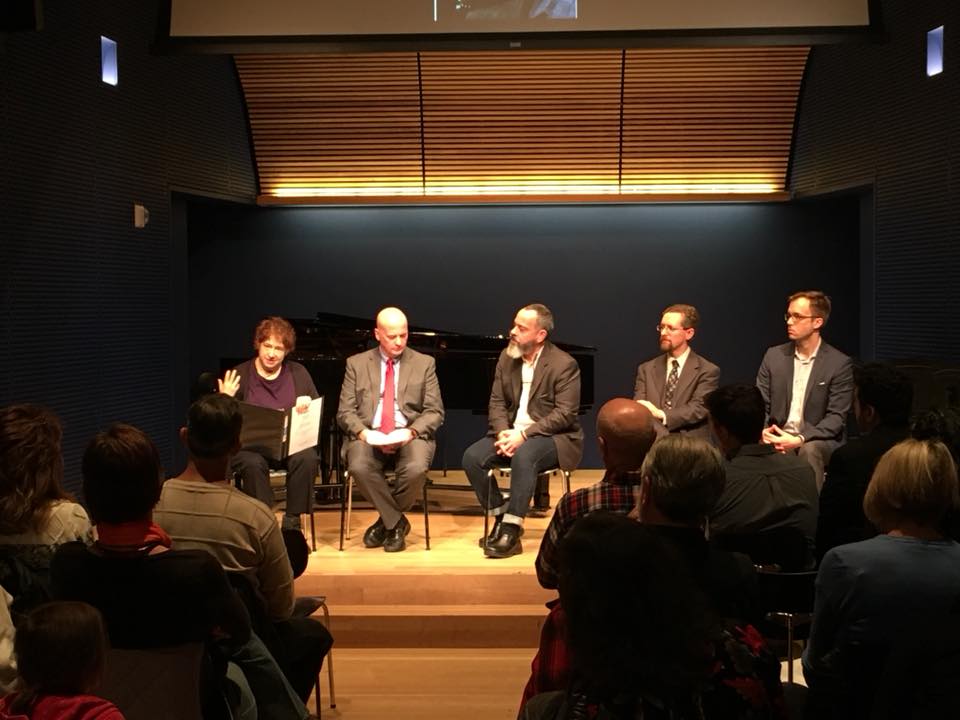
The performance itself is a slightly peculiar thing: without the benefit of a fully staged production, with set, costumes, lighting, or an orchestra, most of the story telling relies on the singers and whatever interaction they can have with each other within the constraints of the format. An added difficulty lies in the fact that each singer portrays several characters throughout the piece. Projected slides above, as well as information in the program was designed to help the audience follow the story, mostly by indicating where the action is taking place, and what characters are in the scene.

After the performance, just like after the libretto workshop, Cori Ellison led the audience thought a moderated feedback session: she used Liz Lerman's critical response process for this, which is comprised of four parts:
  1. Statement of meaning: audience members express what was meaningful to them, what "got" to them in the piece. These should be specific, and positive comments, such as "I loved it when...", or "I was moved by...".
  2. Questions from the librettist to the audience: the writer asks, the audience responds, and a dialogue ensues. For instance: "Was it clear to you that...?", "what did you think of...?".
  3.  Questions from the group to the librettist: sometimes what is clear to the librettist is not clear for the audience, and some points of the plot might need clarification. This is helpful for the composer/librettist in order to gain a different perspective than his own on the work.
  4. Opinions: audience members can express opinions about any aspect of the work BUT, they have to ask the writer whether he/she would like to hear them. Sometimes, hearing an opinion might influence the piece too much, or inadvertently push it in a direction that wasn't the writer's initial intent. The audience member would ask: "I have an opinion about such and such, would you like to hear it?".
 
The response was overwhelmingly positive, and much was said about how clear and gripping the storytelling was; surely a great testament to Tom's incredible skill, dramatic instinct, and beautifully evocative music.

You can watch the whole reading as well as the feedback session by clicking on the link below. I am also copying the program description in order to make it easier to follow who is who and where each scene takes place.

https://www.youtube.com/watch?v=-ZJ9Vr3BL88

If you would like to know how what happens in Act 3 and how the story ends, come to the premiere in November at The Crane School of Music, SUNY Potsdam, in Potsdam, NY. You can visit the Pellicciotti Facebook page, to stay up to date on the project.


A Musical Reading of the First Two Acts of

Mayo

Winner of the 2018 Domenic J. Pellicciotti Opera Composition Prize
Composer and Librettist – Tom Cipullo
Conductor – Kirk Severtson
Pianist and Coach – François Germain
Director – Dean Anthony
Dramaturg – Cori Ellison

Featuring
                                                                              Mayo Buckner: Ben Edquist 
                                                                 Valeria, Soprano roles:  Emily Misch 
                                            Mrs. Buckner, Carolyn, Mezzo roles: Rebecca Ringle Kamarei
Leader of the Eugenicists, Beckmann (an orderly), Tenor roles: Jason Weisinger 
                                                   Superintendent, Baritone roles: Steven Eddy 
                                                                  Ms. Goodrich, Chorus: Samantha Martin
                                                                                     Jo, Mezzo: Gianna Grigalonis
                                                                     Wimpy, Tenor roles: Tristan Lesso
                                                                      Jimmy, Tenor roles: Kirk McAuliffe
                                                                 Timmy, Baritone roles: Wesly Clerge
                                                            Eugenicist, Baritone roles: Henry Horstmann

Act I – Autumn

Preamble:       On a train, 1906.
Prologue:         A public street in middle America, ca. 1906. A group of eugenicists are   recruiting marchers and passing out signs for a rally.
Scene 1:          The Superintendent’s Office, the Iowa Home for Feeble-Minded Children,
                        Mrs. Buckner, Ms. Goodrich, Superintendent. 1906
Scene 2:          A Boys’ Dormitory at the Iowa Home, 1927.
                        A group of boys, Mayo, Beckmann, Ms. Goodrich

Act II – Valeria

Scene 1:          In the garden of the Iowa Home, Autumn 1927.    
                        Jo, Valeria, Carolyn, Beckmann, Mrs. Goodrich
Scene 2:          In the Chapel at the Iowa Home, later that week. 
                        Valeria, Mayo, Ms. Goodrich
Scene 3:          In the Superintendent’s office, later that day. 
                        Ms. Goodrich, Superintendent, Beckmann, Mayo


Monday, November 27, 2017

Britten, Physics and Phonics

While I was at the International Congress of Voice Teachers this past summer, I happened upon a seminar given by an old friend of mine, Dr. Kevin Hanrahan, who is Associate Professor of Voice at the Glenn Korff School of Music of the University of Nebraska-Lincoln, and Matthew Clegg, a DMA voice student at the same university. The seminar was entitled Benjamin Britten: A Study in Vocal Acoustics, and focused on Britten's Serenade for Tenor, Horn and Strings, and A Charm of Lullabies for mezzo-soprano, looking into how the composer set the text, to see if the singer simply sang exactly as the text (specifically the vowels) as composed whether it would match the dynamics and expression that Britten intended. It was so fascinating that I asked him to share some of their findings with us!


Q: When you set up this experiment, what were you trying to prove/discover?

A: After working with Kenneth Bozeman at a Nebraska NATS workshop where he discussed what he calls, "Practical Vocal Acoustics", I had the idea that perhaps Britten was using some of the principles that Bozeman was discussing in the workshop and in his book, Practical Vocal Acoustics.  So, what we were looking to discover was whether or not Britten set the text in such a way as to exploit “passive vowel modification” strategies resulting in a timbre that would coincided with the dynamic making, thus making the music vocally and expressively easier for the singer.  Passive vowel modification differs from Active Vowel modification in that passive vowel modification results from a change of pitch resulting in a harmonic/formant interaction without a change of vowel shape, where active vowel modification is when there is a change in vowel shape so as to create a harmonic/formant interaction regardless of pitch.  The main difference is that the singer has to "actively" change or modify their vowel as opposed to "passively" letting the vowel modify as a result of the pitch. In the end it is a matter of whether you move the pitch (passive vowel modification) or move the formant (active vowel modification).


Q: What made you choose Benjamin Britten as the example?

A: Both Matthew and I are tenors, and we both have a fondness for Britten and his music.  One of the reasons we love Britten so much is that we find it to be so easy to sing from a vocal standpoint, and so easy to sing expressively. Knowing that he was very particular about how he composed his vocal works, and that he composed them with specific individuals in mind, we thought he was a natural choice to explore the relationship between the timbres resulting from passive vowel modification and dynamics.

Q: How can we use physics to prove this?

A: Physics doesn’t necessarily “prove” anything, but it does help us explain what we observe.  What we now know is that for "covering" to occur the second harmonic (H2 or 2F0) has to rise above the first vowel formant (F1) or F1 has to be lowered below H2 usually by lengthening the vocal tract which can occur from depressing the larynx, puckering the lips, changing a vowel shape, etc.  This passing of the H2 through F1 is what Bozeman calls "Closed" Timbre. So, using [a], which has a F1 at approximately G5 (middle C is C4), as an example, if one were to sing a tenor "high A" or A4 on an [a] vowel one would only need to maintain the [a] vowel shape to achieve "cover", the crossing of H2 (A5) above F1 (G5).  If one wanted to actively modify by puckering slightly, this would then shift F1 to a lower pitch, perhaps (E5 or F5) and increase the "Closed" or "Covered" quality of the sound. If F1 is continually lowered to where it is just above or in tune with H1, the fundamental, then a new quality takes over, what Bozeman calls “Whoop”.  “Whoop” is a very fluty, light quality that is often associated with soft dynamics or falsetto sounds.  In contrast to “Whoop” is a quality Bozeman calls “Yell” which occurs when F1 is tuned to H2, and as its name suggests is associated with aggressive and loud dynamics.  The last timbre that Bozeman labels is “Open” which also has an association with loud dynamics, and occurs when F1 is above H2.  Now these qualities can be associated with different laryngeal modes, for example, Mode 1 is associate with “Open”, “Close”, and “Yell” timbres, where Mode 2 is associate with “Whoop”.  Looking at the research of Fabiani and Friberg, their study looked at the influence of pitch, loudness, and timbre on instrument dynamics.  They report that dynamics can even be recognized if the loudness (not intensity) is the same, therefore loudness can only partially explain dynamic recognition. They argue that timbre is that missing factor. So, if you put these pieces together then, you have timbres that coincide with dynamics via established vocal registers or modes.  Using the F1/H2 interaction, you can then predict what the likely resulting timbre or vocal register/mode is based on the vowel and pitch, and therefore, the likely resulting dynamic.  If the predicted dynamic matches the dynamic indicated by Britten, then the expressiveness of the singing would be more naturally and easily accomplished.  Furthermore, if the timbre, dynamic, and pitch corresponded with the most conducive vocal register or mode, it would also be vocally easier to sing.


Q: How did you set the parameters?

A: For the timbre prediction we used Kenneth Bozeman’s book, Practical Vocal Acoustics.  To determine the vowels for the text we used an online IPA generator set to American English.  We did this because Received British English tended to favor more mixed vowels and not the purer, if you can call American vowels pure, American vowels.  For example, the word “blow” in American English is [bloʊ] but in British English is [bləʊ]. We confirmed this by listening to British tenors who were well-known for their interpretation of Britten’s music.  When the transcription software didn’t produce a transcription, we looked up the word in the Oxford English Dictionary.  Following standard classical diction rules, i.e. Madeleine Marshall’s Singer’s Manual of English Diction, vowel and “r” combinations were all muted, i.e. changed to [ə].  For the formant pitches we adapted Scott McCoy’s suggested pitches in conjunction with Lindsey’s combination of Well’s and Jones’ vowel chart.  To determine when one timbre was truly different from another, we looked at research about pitch perception and harmonics. We determined that a plus or minus of a major 2nd was sufficient to properly identify a timbre.  For example, if F1 was C5, then if H2 was between Bb4 and D5, we would conclude that H2 was tuned to F1 resulting in “Yell” timbre. Finally, we associated the timbres with dynamics using established descriptors for the vocal registers, and dynamics shaping was approximated by increasing or decreasing the dynamic level one level, i.e. p to mp, every two beats.  The predicted dynamic shaping was compared to a recording of a well-known tenor and mirrored the tenor’s dynamic shaping quite well.

Q: How can you tell whether the vowels and the pitches are a good match?

A: We assigned various dynamics to the timbres, so pp-p was “Whoop”, mp-f was “Closed”, f-ff was “Open” and f-fff was “Yell”.  Then if the predicted timbre matched the marked dynamic, it was a good match.  For example, if the dynamic was forte, then “Closed”, “Open” or “Yell” were considered to be a good match. Then, if the timbre was used in what would be considered an appropriate pitch range, so for a tenor one would expect “Closed” around G4 or higher, that further strengthened the match. We also looked at groups of dynamics/timbres, meaning how often was “Whoop” used correctly with soft dynamics or incorrectly with loud dynamics. What we are doing now is looking a little more carefully at when there wasn’t a good match or when the dynamic isn’t used correctly with the timbre to see if there is a reason why Britten may have chosen to mismatch the timbre and dynamic.  At the moment it looks like this mismatch is occurring to aid projection. 

Q: What was the upshot of the experiment?

A: What we found was that overall, the predicted timbre matched Britten’s dynamic only 25% of the time.  There were occasions, however, when the predicted timbre matched the dynamic as much as 50%, but it depended on the individual song.  Furthermore, we found that Britten often assigned the “correct” vocal register or mode for the dynamic when in the upper portion of the voice.  We also looked at occasions when F2 happened to correspond to H3 or H4.  The supplemental amplification of F2 is a common technique for tenors, and has the effect of aiding diction clarity.  We found the F2 supplemental tuning was occurring over 37% of the time.  It was also frequently being used in the upper portion of the voice and when the dynamic was soft in conjunction with louder timbres which we interpret as being Britten’s attempt to aid the singer in projection at soft dynamic levels.  Finally, we noticed that when the predicted timbre and dynamic did not match, the timbre shifts mirrored the dynamic shifts, i.e. a shift from “Closed” to “Open” would correspond to a dynamic change of p to mp, etc., as if Britten were cueing the singer as to how a line should be shaped.


Q: How is this useful for singers? Should it change their approach to the text/performance?


A: The big take away for singers here is that with Britten, if you just sing the pitch and the vowel he asks, you will likely sing the dynamic or dynamic shaping he wants.  In other words, Britten has programmed by his choice of pitch and vowel, how to sing his music.  We think this type of analysis would be beneficial to singers, at least on a macro level.  Both of us teach singing, and we frequently see singers making their lives more difficult by imposing an interpretation on a piece.  If they would just take a moment and consider what might happen if they just sing what is on the page, they may find that they don’t need to work as hard to provide a musically pleasing product.  Of course, this is not always true, but it would seem logical, at the very least, to begin from that point of view.  We think this type of analysis also has a tremendous impact on the practice of transposing art songs, particularly. It has become very popular for women to sing song repertoire that was originally composed for men and vice versa. If you have a composer, like Britten, who was very specific about what colors or timbres they wanted from the singer and was also adept at building that into their composition, transposing them or simply singing them up or down an octave would destroy the composer’s artistic concept, not to mention making it very difficult vocally to sing the music.  For example, in Britten’s “Nocturne” from Serenade, he has very carefully chosen his pitch/vowel/dynamic combinations, a 50% match and 64% match above C4.  To have that piece sung by soprano an octave higher would completely destroy those combinations resulting in either the soprano not accomplishing what Britten has asked for or accomplishing it with great difficulty and vocal manipulation. It is really wise to do that?  With some composers, who are less intentional and adept, this may not be an issue, but it is important to consider.  So, we would say that this analysis definitely is useful in aiding interpretation, and vital when considering singing repertoire in transposition.


**********
In case we needed another reminder that singing the text and the proper vowels is important, here we have it! 

--Ellen

Tuesday, October 31, 2017

Making a choice

I still remember the specific moment that I truly decided to make music. Don’t get me wrong, I was pretty much always going to become a musician, that was never really in doubt. My mom was a pianist and music teacher, I’ve been playing piano since I was able to sit upright (see me and my brother below :-) ) and singing even longer than that—but somehow never made the real conscious decision to make music until I was 19. 


It was in piano class; I was a sophomore in college and my fellow classmates were both grad students. Maumack had already played, and Helen was up, playing Chopin’s G-minor Ballade. Just as she hit the coda, something inside me changed—it felt like my heart opened, tears filled my eyes, and my soul was touched in a way that I’d felt before but never so clearly, and I thought, “I need to do that”. So when it was my turn, I’m sure they were waiting for me to play my Beethoven 32 Variations basically technically well, but I made a different choice. I chose to make music, rather than to play every note correctly. It was a huge moment, and I honestly will never forget the looks of respect, encouragement, and hope that I saw on my fellow students and my teacher Ralph  Zitterbart’s faces.


The funny thing is, I crashed and burned during that performance! About 2 pages from the end, I lost my place and couldn’t get back to it, and I ended up stopping. But they were all so excited and thrilled at the way I had just played that I could see they knew how far I had come in those 15 minutes. 

The moral of the story for me is—it’s not about getting to the end. It’s about the journey. Take people with you on that journey and it doesn’t matter what you do or where you end up, just that you shared it with them.

From that moment on, my choice has always been to make music—working on technique became the means to that end, rather than an end in itself. The hardest thing about that choice was that suddenly everything became more important, and for a very long time I was more nervous than I’d ever been! It’s one thing to play all the notes right—it’s a whole new ballgame when you pour your heart and soul into something and people criticize it. I’ve had singers come in to coachings sometimes where they just sort of sing through the song, assuming that I’ll correct pitches and diction and style, and technically, yes, that’s my job. But the pitches and diction and style are all informed and enhanced by the music you’re trying to make, by the story you're trying to tell, so by committing to that music in every coaching, in every lesson, everything else will improve. Just as we say singers should mark with their voice, not their body, singers should mark with their voice, not their intentions.


In this age of younger, faster, louder, auto-tune, and CDs with single notes corrected or improved, as musicians it’s important to get back to the basics. Make music. Share it with people. That’s why people still come to see live performances—they want to be transported with you. So if you haven’t already done so, commit to making music, rather than to singing or playing the piano. In the end, it will pay off a million-fold.

--Ellen